Parasport refers to sports that are designed for persons living with a disability. Parasports can be played both competitively, all the way up to the Paralympic level, and at the recreational level.
Parasports can be offered in many different forms. Some are offered as a stand-alone program (all players have similar disabilities) such as goalball, and some are integrated programs (a mix of players living with a disability and abled-bodied players) such as athletics and swimming. Many sports use a classification system that puts athletes with similar mobility on an even playing field with each other.
While designed for persons living with a disability, many parasports can be played by people of any age or ability, living with or without a disability. They create a level playing field where athletes of all abilities can play together.
Our partners and volunteers help to make parasport in Nova Scotia a reality and change lives through sport.
Zachary Dickson (He/Him) Parasport Consultant Sport Nova Scotia 5516 Spring Garden Road, 3rd Floor Halifax, NS B3J 1G6 902-425-5450 ext 375 parasport@sportnovascotia.ca
Parasport in Nova Scotia
In Nova Scotia, parasports are governed by the Provincial Sport Organization (PSO) for each individual sport. Individual programs are then run by a variety of community organizations. There is programming available for athletes of all ages at recreational and competitive levels.
Click the sport icons below to access a pop-up that contains a description of the parasport, and how to get more info about opportunities to participate.
Blind Hockey
Blind hockey is a variation of ice hockey for athletes of all ages who are blind or partially sighted.
The sport uses some modified rules and equipment including:
The puck is three times larger, made of metal and makes noise.
The nets are three feet tall instead of four feet tall.
A pass is needed after passing the blue line before shooting. A pass whistle indicates to the players that they may attempt to score and at the same time lets the defensive players and goalies know a shot may be coming.
Click here for lists of Nova Scotia parasport programs by region.
Boccia
Boccia is a Paralympic sport that can be played by anyone, with or without a disability. Boccia is played indoors on a court that is similar in size to a badminton court.
Boccia is a co-ed sport of control and accuracy similar to curling or lawn bowling. Games last four or six ends. Players propel balls towards the target or “jack” ball. Each side has six balls (red or blue) per end to try and score points. The closest side to the target ball when all the balls have been played, scores.
If you can't throw the ball, you can roll it or kick it. If a player cannot roll the ball or hit it with the foot, they can use a ramp.
Click here for lists of Nova Scotia parasport programs by region.
Challenger Baseball
Challenger baseball is an adapted baseball program that provides an opportunity for children and youth with any cognitive, sensory and/or physical disabilities to play organized baseball at a level structured to their abilities.
The objectives of the program are to provide opportunities and experiences to children and youth with varying abilities, to empower participants through baseball and physical activity, to teach core life skills learned through sport and to make new connections and friendships.
Click here to learn more about challenger baseball.
Click here for lists of Nova Scotia parasport programs by region.
Goalball
Goalball is a Paralympic sport exclusive to athletes with visual impairments, played by both men and women.
Goalball is played in a gym. The objective of the game is to throw the ball using a bowling motion into the opponent’s net while the opposing players try to block the ball with their bodies.
Goalball is played on a court with tactile markings to help orientate the players to their location on the court. The ball also has noise bells which help players track the direction of the ball.
Click here for lists of Nova Scotia parasport programs by region.
Para Alpine Skiing
Alpine skiing is a winter sport that is an adaptation of alpine skiing for athletes with physical or visual impairments which involves descending a snow covered hill with either skis, or a sit ski.
Para alpine skiing can be done by anyone with a number of adaptions possible depending on the participants’ ability level, including sit-skis, outriggers and guides for visual impairments.
Click here to learn more about para alpine skiing.
Click here for lists of Nova Scotia parasport programs by region.
Para Archery
The objective of archery is to shoot arrows accurately at a target marked with 10 rings. A hit in the center ring (bull’s eye) scores 10 points, with the following zones decreasing in point value until the outer ring, which is worth one point.
Male and female athletes with physical impairments can compete either standing or in wheelchairs.
Click here for lists of Nova Scotia parasport programs by region.
Para Athletics
Para athletics, also known as track and field, is the largest competition at the Paralympic Games.
Events are available for individuals with visual, intellectual and physical disabilities (both wheelchair and standing). Contested events are held in track (sprints and long distance), throws and jumping.
Click here for lists of Nova Scotia parasport programs by region.
Para Boxing
Para boxing is an adaptive form of boxing that allows athletes who use wheelchairs to develop boxing skills, fitness, speed, coordination and strategy.
Para boxing uses many of the same fundamental skills as traditional boxing, including punching, blocking, combinations, movement, timing and defence. The sport is adapted so athletes can compete effectively from a wheelchair.
For competitive para boxing, athletes are matched according to factors such as age, weight and classification to help create fair and competitive matchups.
Click here for lists of Nova Scotia parasport programs by region.
Para Canoe
Paracanoe is an adaptation of paddling to accommodate paddlers with physical disabilities. Each boat is adapted according to the functional abilities of its crew members.
The two main boats are the kayak (K) and va’a (V) boats. Kayak boats are propelled by a double-blade paddle. Va'a boats have an AMA (pontoon) for additional stability and are propelled by a single-blade paddle.
Click here for lists of Nova Scotia parasport programs by region.
Para Cycling
Para cycling is an adapted version of cycling or biking using adaptive equipment such as handcycles, tricycles and recumbent bicycles.
Handcycles are similar to bicycles but allow users to pedal with their hands instead of their feet. Tricycles offer addition support and balance compared to two wheeled bicycles. Recumbent bikes are designed so you sit lower to the ground with your legs out in front of you with the steering and hand controls down at your side.
Click here for lists of Nova Scotia parasport programs by region.
Para Equestrian
Para equestrian is an adapted version of equestrian. There is both recreation focused therapeutic riding and competitive focused dressage events.
Therapeutic riding is a challenging and invigorating form of exercise and recreation that gives the rider a sense of accomplishment and increased self-esteem. For individuals with disabilities that affect mobility, the horse provides freedom of movement and independence from assistive devices such as wheelchairs and crutches.
In dressage, para equestrian athletes can compete alongside able-bodied riders. Riders are judged on their ability to perform various patterns, which include changes in pace and direction.
Click here for lists of Nova Scotia parasport programs by region.
Para Golf
Like many adaptive sports, para golf allows persons living with disabilities to play the game of golf through modified rules or equipment, based up the person’s abilities.
Golf is a sport in which the player uses specialized clubs to attempt to sink a ball with as few strokes as possible in to each of the nine or 18 successive holes on a course.
Click here for lists of Nova Scotia parasport programs by region.
Para Hockey
Para hockey (formerly sledge hockey) is an adapted version of ice hockey.
Players are seated in a bucket, which is supported by one or two skate blades, and move themselves with sticks that are spiked at one end and have curved blades at the other for shooting.
Click here for lists of Nova Scotia parasport programs by region.
Para Karate
Para karate is a parallel form of karate for athletes living with a disability.
Para karate is open to wheelchair users, visually impaired athletes and athletes with intellectual disabilities and focuses primarily on kata, which is choreographed sequences of karate movements (rather than kumite, which is sparring).
Click here for lists of Nova Scotia parasport programs by region.
Para Nordic
Para nordic is an adapted version of cross country skiing.
Cross country skiing is a form of skiing where skiers rely on their own power to move across snow-covered terrain.
There are a number of adaptions possible to make cross country skiing accessible for physically and visually impaired athletes including sit-skis and guides.
Races are held in distances from one to 20 kilometres.
Click here for lists of Nova Scotia parasport programs by region.
Para Powerlifting
Para powerlifting is a Paralympic sport that tests an athlete's upper-body strength.
Athletes compete in the bench press, lying on a specially designed bench, with the goal of lifting the greatest amount of weight possible. Each athlete receives up to three attempts and the heaviest successful lift determines their final result.
Para powerlifting is open to athletes with eligible physical impairments affecting areas such as muscle power, range of movement, limb deficiency, leg length, coordination or muscle tone. Athletes compete in one sport class and are separated by gender and weight category.
Click here for lists of Nova Scotia parasport programs by region.
Para Rowing
Para rowing is an adapted version of rowing.
Rowing is a sport that involves propelling a boat using a fixed oar as a lever across a body of water. The classifications for para rowing are: arms and shoulders (PR1), trunks and arms (PR2) and legs, trunks and arms (PR3).
Rowing competitions are open to athletes with physical impairments including reduced muscle power, athetosis, impaired passive range of movement, hypertonia, limb deficiency, ataxia and vision impairment.
Click here for lists of Nova Scotia parasport programs by region.
Para Sailing
Sailing is the sport of using wind to power sails and propel a boat over water.
Para sailing utilizes various forms of adaptive technology to enable people with severe physical limitations to participate equally with able-bodied sailors.
Sailing allows those with disabilities to enrich their lives and build confidence, while providing empowerment, motivation and quality of life.
Click here for lists of Nova Scotia parasport programs by region.
Para Snowboarding
Snowboarding is a winter sport that involves descending a hill that is covered with snow while standing on a board attached to the rider’s feet.
Para snowboarding can be done by anyone with a number of adaptations possible depending on the participants’ ability level including sit-skis, outriggers and guides for visual impairments.
For competitive para snowboarding, athletes are classified according to how their impairment affects their ability to snowboard. There are currently three sport classes: SB-LL1 and SB-LL2 for athletes with lower-limb impairments, and SB-UL for athletes with upper-limb impairments.
Click here for lists of Nova Scotia parasport programs by region.
Para Squash
Squash, sometimes called squash rackets, is a rack-and-ball sport played by two or four players in a four-walled court with a small, hollow, rubber ball.
The players alternate in striking the ball with their rackets onto the playable surfaces of the four walls of the court. There are various versions for different disabilities including Squash 57 for wheelchair users.
Click here for lists of Nova Scotia parasport programs by region.
Para Swimming
Para swimming offers a fully integrated swimming program for people with a physical, visual or intellectual impairment from recreational to competitive levels.
It is a Paralympic sport with athletes competing in strokes and distances similar to able-bodied swimming, but classifications based on how their eligible impairment affects their ability to perform the sport.
Click here to learn more about adaptive artistic swimming.
Click here for lists of Nova Scotia parasport programs by region.
Para Waterskiing
Para waterskiing is an adapted version of waterskiing and wakeboarding.
Para waterskiing allows towed water sports enthusiasts with a range of impairments to get behind a boat on top of the water by using adaptive ski equipment and specialized techniques.
Click here for lists of Nova Scotia parasport programs by region.
Para Waterskiing
Powerchair soccer is played on a standard-sized basketball court. Each team is allowed four players on the court at one time, all of whom use an electric wheelchair to move themselves and the ball. Guards are attached to the chairs to allow the ball to be hit around the court.
A match consists of two 20-minute periods.
The sport uses an oversized soccer ball that has a diameter of 13 inches and weights more than two pounds. Much heavier than a conventional soccer ball , this stops the ball from leaving the ground during play.
Click here for lists of Nova Scotia parasport programs by region.
Sitting Volleyball
Sitting volleyball is an adapted version of volleyball.
Volleyball is a game played by two teams in which the players use their hands to hit a ball back and forth over a high net, trying to make the ball touch the court within the opponents' playing area before it can be returned.
To play sitting volleyball individuals need to have their bottoms on the floor. Players typically move and play the ball with their hands which makes the game great for lower limb amputees and mild cerebral palsy, but ALL abilities are welcome to play.
Click here to learn more about sitting volleyball.
Click here for lists of Nova Scotia parasport programs by region.
Speed Sledge
Speed sledge is an adaptation of speed skating for skaters living with a physical disability. Each racer participates using a para hockey sledge.
Sledge racing was one of the first sports included in the Paralympic Games and was last included in 1998 in Nagano, Japan.
Click here for lists of Nova Scotia parasport programs by region.
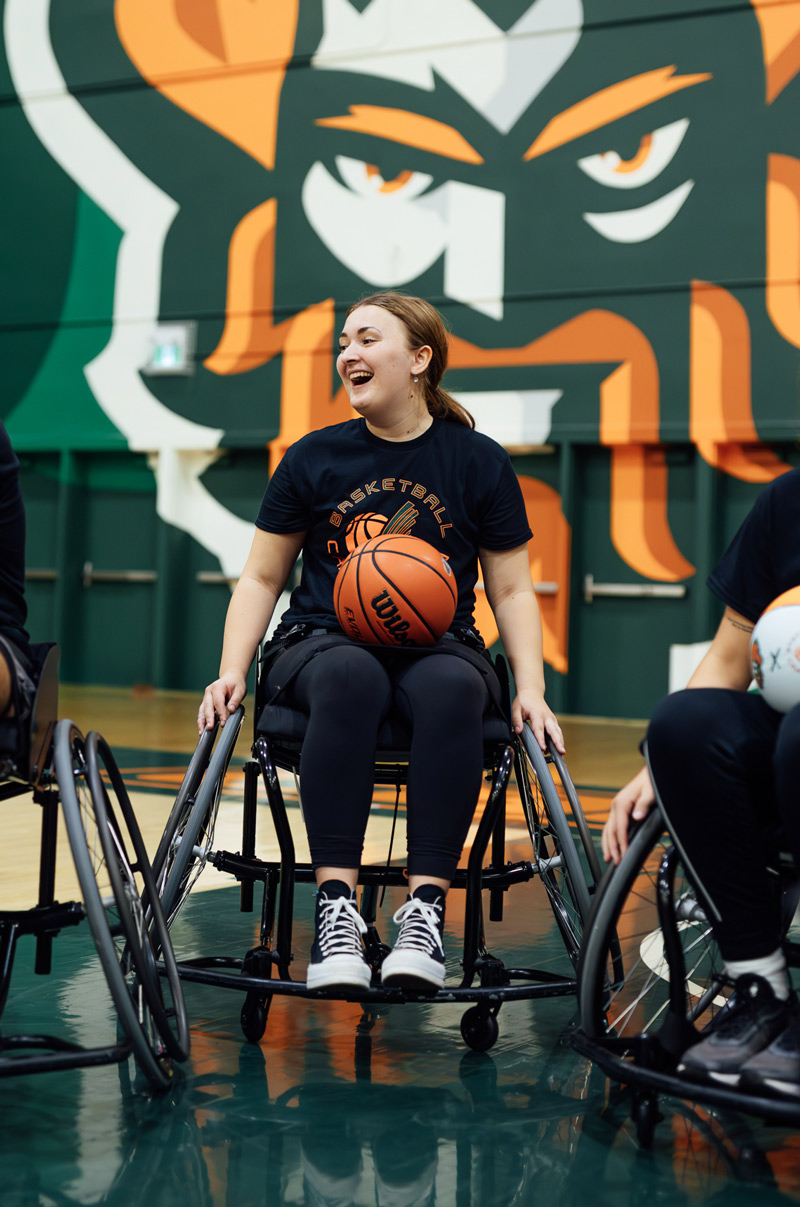
Wheelchair Basketball
Wheelchair basketball is an adapted version of basketball that is fully inclusive.
Like standing basketball, the object is to shoot the ball into the opposing team’s basket. Teams are comprised of three or five players and players are seated in a sports chair. Games consist of four quarters.
Click here to learn more about wheelchair basketball.
Click here for lists of Nova Scotia parasport programs by region.
Wheelchair Curling
Wheelchair curling is a fully inclusive sport. Wheelchair players can play in separate wheelchair curling leagues, or be integrated into either stand up or stick curling games where able bodied players and wheelchair players can play together.
Curling is a sport in which players slide stones on a sheet of ice toward a target area in the shape of a circle.
In wheelchair curling there is no sweeping, which means each throw has to be even more precise. The player’s wheelchair must be stationary during the throw and the stones can be thrown by hand or give an initial push with a delivery stick.
Click here to learn more about wheelchair curling.
Click here for lists of Nova Scotia parasport programs by region.
Wheelchair Pickleball
Wheelchair pickleball is an adapted version of pickleball played from a sport chair.
Players in wheelchairs can play in singles or doubles as in standing pickleball or in teams made up of a wheelchair player partnered with a standing player.
A few modifications have been made for the wheelchair athlete, including a double bounce and the front wheels of the chair being allowed to cross the non-volley line.
Click here to learn more about wheelchair pickleball.
Click here for lists of Nova Scotia parasport programs by region.
Wheelchair Rugby
Wheelchair rugby is a co-ed team sport for athletes with a mobility-related disability in at least three limbs. It is a unique sport created by athletes with a disability that combines elements of basketball, handball and ice hockey.
The object of the game is to carry the ball across the opposing team’s goal line. Two wheels must cross the goal line for a goal to count, and the player must have firm control of the ball when they cross the line.
All wheelchair rugby players compete in specialized sport chairs.
Click here for lists of Nova Scotia parasport programs by region.
Wheelchair Tennis
Wheelchair tennis is an adapted version of tennis.
The game is played on a standard tennis court. The main rule difference with standing tennis is that the ball is allowed to bounce twice before being returned and players are seated in sports chairs.